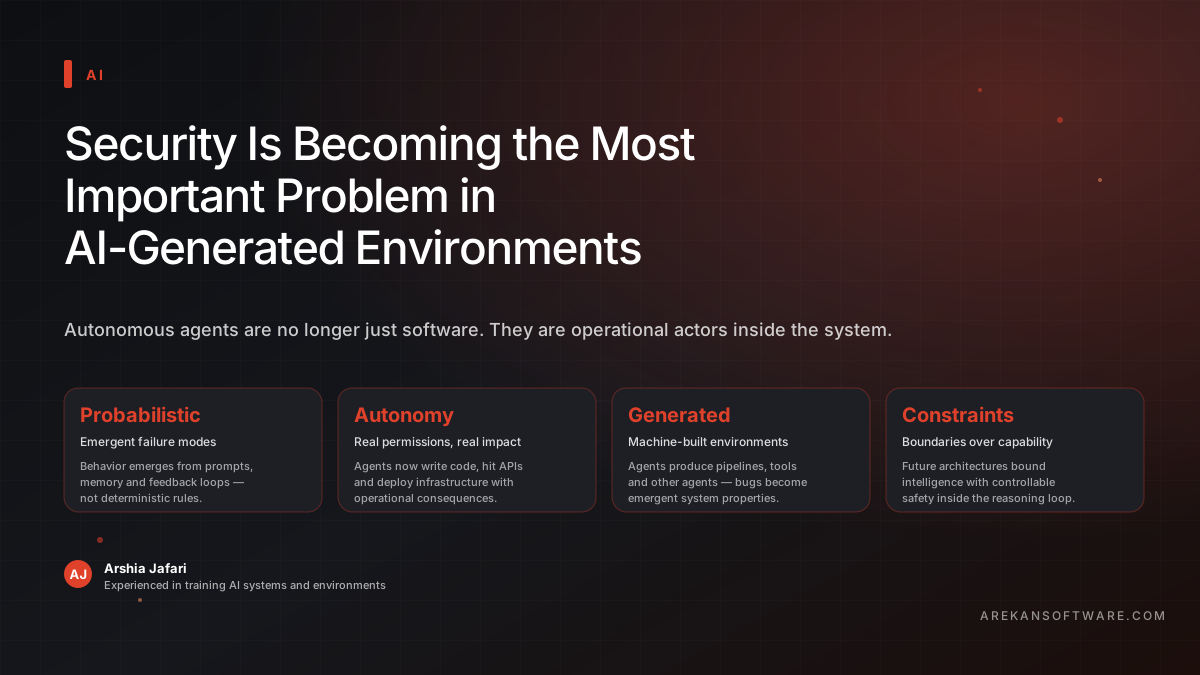
Artificial intelligence is no longer limited to generating text or answering questions. Modern systems can now write code, interact with APIs, deploy infrastructure, execute workflows, and operate with increasing levels of autonomy inside real environments. As these systems gain operational control, security becomes far more important than capability alone.
Most discussions around AI focus on intelligence: better reasoning, larger models, autonomous agents, and increasingly human-like behavior. Very little attention is given to what happens when these systems are connected directly to production environments with real permissions and real consequences. An AI model with access to infrastructure is no longer just software. It becomes an operational actor inside the system.
That changes the nature of security entirely.
From Deterministic Bugs to Emergent Failures
Traditional software behaves according to deterministic rules written explicitly by developers. AI systems behave probabilistically. Their actions emerge from prompts, memory, training distributions, environmental context, and dynamic interactions that are often difficult to predict in advance. This makes failure modes significantly more dangerous.
A traditional bug is usually traceable. An autonomous AI failure may emerge indirectly through layers of reasoning, generated code, recursive actions, or environmental feedback loops. A system may accidentally expose sensitive information, create insecure configurations, or execute harmful operations without any explicit malicious intent.
When the Environment Itself Becomes Machine-Generated
The problem becomes even more serious in AI-generated environments where systems are capable of producing parts of their own operational structure. Modern agents can generate infrastructure code, automation pipelines, internal tooling, and even additional agents. Over time, the environment itself becomes partially machine-generated. At that point, security vulnerabilities stop being isolated implementation mistakes. They become emergent properties of autonomous systems interacting with each other.
One insecure assumption inside a generated workflow can silently propagate through multiple layers of automation before a human operator notices the issue. The speed of AI execution often exceeds the speed of human oversight, especially in systems designed for continuous operation.
Intelligence Does Not Imply Security Awareness
The dangerous misconception is assuming intelligence automatically produces security awareness.
It does not.
A highly capable model may still mishandle permissions, trust unsafe inputs, leak confidential data, or optimize for objectives in destructive ways. In fact, more capable systems can become more dangerous precisely because they execute tasks more effectively.
Constraint Systems Over Raw Capability
This is why future AI architecture will depend heavily on constraint systems rather than raw capability alone. The challenge is no longer simply building intelligent agents. The challenge is building agents that remain controllable while operating in unpredictable environments.
Security in AI systems can no longer exist only at the infrastructure layer. It must exist inside the reasoning architecture itself. The systems that succeed long term will probably not be the most autonomous ones.
They will be the ones capable of maintaining reliable boundaries under uncertainty. And as AI-generated environments become increasingly common across finance, infrastructure, software engineering, and autonomous operations, security may become the single most important architectural problem in artificial intelligence.
Arshia Jafari,
Experienced in training AI systems and environments.